
What next?
In our experience, there is an elation, a euphoria that is experienced when what is truly meaningful to an organisation is surfaced. It's like a disorientating fog clears and suddenly you can all see the same landscape. You understand what you work so hard for.
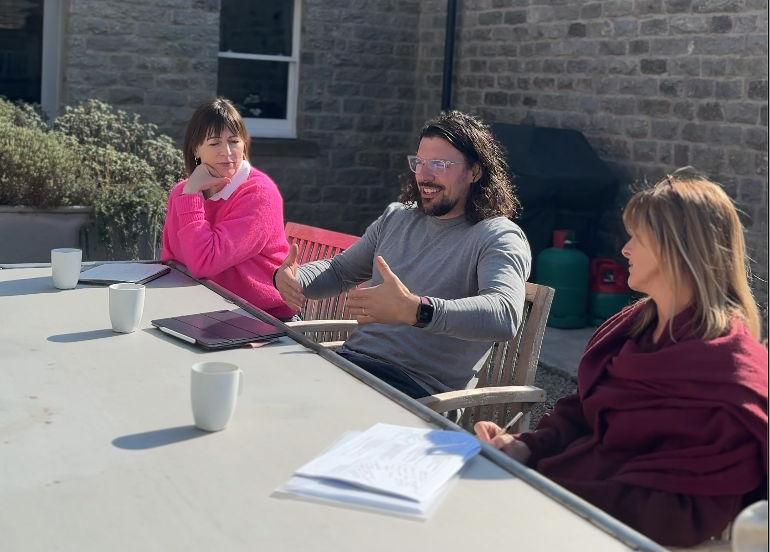
We typically do this during an immersive experience. You invest time in telling stories, those of your own experience, the people around you and those who came before you. You get the opportunity to hear, and more importantly, feel the consequences of being in alignment or misalignment with what is meaningful.
An energetic epiphany is often met with an equal measure of satisfied exhaustion from having done the hard work.
We hear things like, "That's it. That's why I joined and why I'm still here 20 years later," or "That's us at our best. It's what they fight to protect."
And the natural next step is, "We have to use this," "We have to get it out there," "We need to work with the momentum we've created here."
They are always looking, quite rightly, for the what next.
And why wouldn't they? When you've finally found the words to articulate something that has been felt but perhaps never quite understood, there's an overwhelming desire to share it. To give everybody else the same clarity, the same energy, the same sense of direction.
But there's a catch.
Those words are meaningful because of everything that happened before they were spoken. The stories, the disagreements, the moments of recognition, the emotions, the connections made between experiences that, on the surface, seemed unrelated.
The words are the outcome of that work, not a substitute for it.
And yet, in our enthusiasm to share what we've discovered, it's remarkably easy to jump straight to the outcome. The beautifully crafted statement, the posters, the screensavers, the language woven into presentations and company communications.
None of those things are inherently wrong. But without the opportunity for others to explore what sits behind the words, we risk giving people the conclusion without the understanding that made it meaningful in the first place.
“The great enemy of communication, we find, is the illusion of it.”
Leaders, in any capacity, grapple with the most effective way to influence, guide or enable others towards a common goal. For the leaders stepping out of our immersive experiences, that goal is now anchored in a clearer understanding of their organisation's purpose.
Communication, in all its forms, is the conduit of leadership.
How do you articulate the goal? Rally your troops, assess their motivation or understanding? How do you course correct, drive high standards? In short, how is anything achieved if communication isn't clear and thoroughly embedded?
But here is the thing about language, the almost impossible truth about dialogue. Just because we've said something doesn't mean that what we've said is what somebody else has understood.
We might have spent weeks, months even, carefully crafting our message. Researching, planning, structuring our thoughts, choosing exactly the right words to articulate what we mean. By the time those words leave our mouths, they represent a fully formed understanding.
But there is nothing to guarantee that they will arrive that way.
Every person listening brings with them a lifetime of experiences, expectations, beliefs and emotions. They hang their own understanding on the very syllables we've uttered. The same words, heard by different people in the same room, can take on a multitude of meanings.
And the difficult thing is that nobody necessarily knows it's happened.
We believe we've been clear. They believe they've understood. Everybody leaves the room thinking they're heading in the same direction.
There's a principle in aviation called the one-in-sixty rule. A deviation of just one degree will take you approximately one nautical mile off course for every sixty nautical miles travelled. Keep going without correcting it, and that seemingly insignificant difference becomes an enormous distance.
I wonder how often the same thing happens in organisations.
Our leaders' euphoric experience, the "That's why I joined and I'm still here 20 years later," can land very differently with somebody who hasn't shared that experience. Perhaps it's a tepid connection, perhaps something entirely different, depending on the individual.
We begin with what we believe is a shared understanding, only to discover, much further down the road, that we've been travelling in entirely different directions.
The stories behind the words
But here's the thing. We can't remove the individual experiences that shape how people interpret language, nor would we want to. What we can do is give people something shared to draw upon.
And that's where the stories matter.
We talk about data with a soul. The stories of an organisation, its origins, the people who shaped it, the adversity it has overcome, the decisions that defined it.
These aren't simply lovely anecdotes to bring a purpose statement to life. They are the evidence of what has mattered, what has driven people to act and what they have been willing to fight to protect.
When we take the time to share those stories, to explore not just what happened but why it mattered, we begin to build a collective understanding.
So when we talk about growth, we're no longer relying solely on what that word means to each of us individually. We have something else to draw upon.
We can remember the decisions made when the company was just beginning, the risks taken to create opportunities, the moments when doing the right thing mattered more than taking the easy route.
We begin to understand where the language has come from and what sits beneath it.
And importantly, this isn't about everybody having an identical personal connection to every aspect of the purpose.
“And importantly, this isn’t about everybody having an identical personal connection to every aspect of the purpose.”
The purpose and meaning markers have been uncovered through a rigorous exploration of stories and experiences across the organisation. As more people contribute their own stories, they bring further evidence, perspectives and sometimes contradictions. Those contradictions aren't something to dismiss. They're opportunities to explore what else might have been happening, to test our understanding and deepen the work.
Not every story will resonate equally with every person. Nor should we expect it to. One person's experience doesn't represent the entirety of an organisation.
But collectively, those stories provide a shared foundation from which people can begin to explore where they fit, what matters to them and how that connects to what matters to the organisation.
And then comes another grapple
If that's what mattered then, what does it mean for us now?
If that's how we behaved when faced with adversity, what might it ask of us in the challenges we're facing today?
This is where our different experiences and perspectives become a strength.
Because we're no longer debating from entirely different starting points. We're exploring different possibilities, anchored in a shared understanding of what matters.
And this is particularly important when navigating change.
Circumstances change. Markets shift. Opportunities emerge. Challenges arise that an organisation has never encountered before.
But the things that have underpinned an organisation, the meaning markers that have consistently shown up throughout its history, can provide something stable to navigate by.
What they look like in practice might change enormously.
The same meaning marker that once drove somebody to take a difficult stand against an injustice might, in another circumstance, lead somebody to make a financial sacrifice to protect a relationship or create an opportunity for somebody else.
The decisions aren't the same. The circumstances aren't the same. But the underlying meaning is recognisable.
And that is where the value lies.
Purpose doesn't need to prescribe an answer to every challenge. It provides a reference point against which we can explore the possibilities.
Different people will see different opportunities, recognise different risks and bring different interpretations to the conversation. Rather than seeing those differences as a problem to be corrected, they become something to work with.
The grapple is no longer simply what does this mean?
It's if this is what matters to us, what does that ask of us now?
How do we behave in a way that honours what matters, while taking action towards what we're trying to achieve?
Our meaning markers can anchor our behaviours. Our ambition gives direction to our actions.
And the conversation between the two helps us navigate the uncertainty.
So, what next?
Perhaps the next step isn't another communication campaign, another presentation or another beautifully crafted statement.
Perhaps it's giving others the opportunity to do the work of understanding. To hear the stories, explore the experiences and recognise what has mattered, so that when the organisation faces something it hasn't faced before, its people have more than a set of words to guide them.
They have a shared understanding of what matters, and the freedom to work out what that asks of them now.
And importantly, the invitation to explore their different interpretations openly and intentionally. To challenge, question and grapple with what those words mean in the circumstances they face.
Because it's through those conversations that we can move beyond assumed understanding towards genuine clarity of language, and with it, alignment in how we move forward.